
The Complete Guide to Safety Tags for Your Worksite.
- AAA Print Marketing
- 10 Min Read

Walk onto almost any construction site, warehouse or industrial workplace in Australia and you will see them everywhere. A strip of card or plastic tied to a valve, a scaffold pole or a piece of faulty equipment, carrying a short message that could stop someone getting hurt.
Safety tags look simple. In practice they carry real weight. They form part of how Australian businesses meet their obligations under work health and safety law, and they are one of the clearest ways to show that a hazard was identified and controlled.
This guide is written for business owners, site managers and admin staff who order, manage or rely on safety tags day to day. It covers the main tag types, what separates a tag that works from one that fails, and the mistakes that quietly undermine a site’s safety system.
Why Safety Tags Matter More Than Most People Realise.
It is easy to see tags as paperwork. The numbers tell a different story.
Safe Work Australia’s 2025 statistics show that 188 workers were fatally injured at work in 2024, and there were 146,700 serious workers’ compensation claims involving at least a week of lost time, more than 400 serious claims every day across the country. Australia’s current work related injury rate sits at roughly one third of the global rate. Vehicle incidents and falls from a height remain the leading causes of fatal injuries, and machinery operators carry one of the highest fatality rates of any occupation group, at more than five times the overall workplace rate.
Behind a lot of that risk sits equipment that was not properly isolated, a hazard that was not clearly marked, or a piece of scaffolding used before it was signed off. A tag will not stop an accident on its own. What it does is create a simple, visible signal that everyone on site can understand at a glance, plus a written record of who checked what and when.
That record matters for more than day to day safety. When an inspector, insurer or auditor asks how a hazard was managed, a tag with a date, a name and a clear reason is often the first piece of evidence a business can point to. Under Australia’s harmonised work health and safety laws, businesses are expected to manage risks in a way that is reasonably practicable, and a documented tagging system is one of the simplest ways to demonstrate that.

The Main Tag Types & When to Use Them.
Different situations call for different tags. Using the wrong one, or treating them as interchangeable, is one of the most common gaps on Australian worksites.
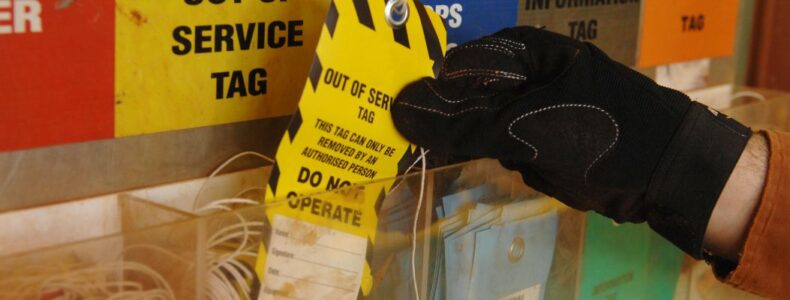
Out of Service Tags
These are attached to plant, tools or equipment that is faulty, damaged or otherwise unsafe to use. They tell workers plainly that the item is not to be operated until it has been repaired and cleared. Out of service tags are typically the first line of defence against someone unknowingly using broken equipment.
Danger Tags
Danger tags are used where operating a piece of equipment or entering an area would cause serious injury or worse. They are usually applied alongside a lockout device during maintenance or repair work, and only the person who applied the tag should remove it. This is a strict rule under safe isolation practice, not a suggestion.
Scaffold Tags
Scaffold tags confirm the current status of a scaffold, typically whether it is complete and safe to use, still under construction, or not to be used at all. Because scaffolds change condition as work progresses, these tags need to be updated regularly and checked before each shift.

Lockout Tagout Tags
Lockout tagout tags support the isolation of hazardous energy sources, electrical, hydraulic, pneumatic or mechanical, while maintenance is carried out. The tag itself is a warning device rather than a physical barrier. The lock does the physical work of preventing re energisation, while the tag communicates who applied the isolation and why. Australian standards such as AS and NZS 4836 for low voltage electrical work, and AS 4024.1603 for machinery safety, provide detailed guidance on how isolation and tagging should be carried out together, including the use of locks and tags to isolate electrical circuits at the switchboard.
Inspection and Test Tags
These tags record when an item, commonly electrical equipment, ladders or lifting gear, was last inspected or tested, and when the next check is due. They are a practical way to keep track of maintenance schedules across a large number of assets without relying on memory or a separate spreadsheet that nobody checks in the field.
What Makes a Safety Tag Fit for Purpose.
Not every tag on the market will hold up on a real Australian worksite. A few practical qualities separate a tag that does its job from one that quietly fails.
Durable Materials
Outdoor sites, whether construction, civil or industrial, expose tags to sun, rain, dust and rough handling. A tag needs to resist tearing and hold up to the weather it will actually face, not just look presentable in a box. Cheap paper stock might be fine for a short indoor job. It is the wrong choice for anything left outside for more than a day or two.

Legibility
A tag that cannot be read from a normal working distance is not doing its job. Clear, high contrast printing, sensible font sizing and simple layout all matter more than they might seem to on paper.
Tear Off Sections for Record Keeping
Many tags include a tear off strip so a duplicate record can be kept in a logbook, folder or register while the main tag stays on the equipment. This is a small design feature that makes a genuine difference to audit trails, particularly on larger sites where several people might apply or remove tags across a shift.
Colour Coding Conventions
Consistent colour coding, red and black for danger, yellow and black for out of service or caution, and so on, allows workers to understand a tag’s meaning before they even read the text. This only works if a business sticks to the same conventions across every site and every supplier. Mixing colour systems, even with good intentions, creates confusion rather than clarity.
Common Mistakes Businesses Make With Safety Tags.
A handful of avoidable mistakes turn up again and again across Australian workplaces.
Using the wrong tag for the situation. An out of service tag used where a danger tag is needed sends the wrong message and can encourage someone to treat a serious hazard casually.
Tags that fade or degrade before the job is finished. A tag that becomes illegible after a fortnight on an outdoor site has effectively failed, even if it looked fine on the day it was applied. If equipment stays isolated or unsafe for longer than the tag can survive, the record disappears exactly when it is needed most.
Inconsistent tagging across a site. Different teams or contractors using different tag styles, colours or wording undermines the whole point of a shared visual system. New starters and visiting contractors in particular rely on consistency to understand hazards quickly.
None of these mistakes are complicated to fix. They usually come down to sourcing the right tags in the first place and applying them consistently once they arrive.

Why Print Quality Matters More Than People Expect.
This is where a lot of businesses get caught out, often without realising why their tagging system is not working as well as it should.
A safety tag is only useful for as long as it can be read and trusted. If the ink fades, the card curls or tears, or the colour coding becomes hard to distinguish after a few weeks outside, the tag has quietly stopped doing its job well before anyone notices. On a site where equipment might sit isolated for weeks during a shutdown or major repair, that gap can be significant.
Print quality is not just about how a tag looks on day one. It is about whether the stock, ink and finish can survive the conditions the tag will actually face, sun exposure, moisture, handling by gloved hands, and general wear. Tags produced to a proper commercial standard, on suitable material with durable printing, tend to hold their legibility for the length of a typical job. Tags produced cheaply or as an afterthought often do not.
For a business relying on tags as part of its safety and compliance system, this is not a minor detail. It is the difference between a record that stands up during an audit and one that has already faded into an unreadable smudge.
Practical Takeaways.
A reliable tagging system does not need to be complicated. A few consistent habits make the biggest difference.
- Match the tag to the situation. Keep a clear, shared understanding across the team of when to use out of service, danger, scaffold, lockout tagout and inspection tags.
- Set and stick to one colour coding system across every site, contractor and supplier.
- Choose tags made from materials suited to where they will actually be used, indoors or outdoors, short job or long shutdown.
- Use tags with tear off sections where a written audit trail matters, and keep that record somewhere it will actually be checked.
- Review tag stock periodically. If tags are fading, tearing or becoming hard to read before the job is done, it is worth reassessing the supplier or material, not just reordering the same product.
- Treat tagging as part of your broader work health and safety system, not a separate box ticking exercise.
Getting these basics right protects workers, supports compliance, and gives a business a clear record if it is ever asked to show how a hazard was managed.
If it would help to review what your business currently has on hand, AAA Print Group stocks a full range of safety tags and can produce custom designs or bulk orders to suit your site, your branding and your compliance requirements.
Sources.
- Safe Work Australia, Key Work Health and Safety Statistics Australia 2025: data.safeworkaustralia.gov.au/insights/key-whs-statistics-australia/latest-release
- Safe Work Australia, media release on national WHS data: safeworkaustralia.gov.au/media-centre/media-release/using-data-make-workplaces-safer-every-job-every-day
- AS/NZS 4836 (safe working on or near low voltage electrical installations) and AS 4024.1603 (safety of machinery) are published by Standards Australia and referenced in industry guidance such as nextdaysafety.com.au/the-ultimate-guide-to-lockout-tagout-for-australian-workplaces.
Let’s Work Together.
Backed by nearly 50 years of industry experience, we’re ready to support your business with strategic solutions designed to make an impact.
Our Clients.














































































Ready to Find the Right Print Solution for Your Business?
Take your business further with print solutions that work. Contact us today to see how we can boost efficiency, safety, and brand impact.